
OKC Thunder 2026-27 Roster Construction: Bouncing Back After Injury-Plagued 2025-26 Campaign
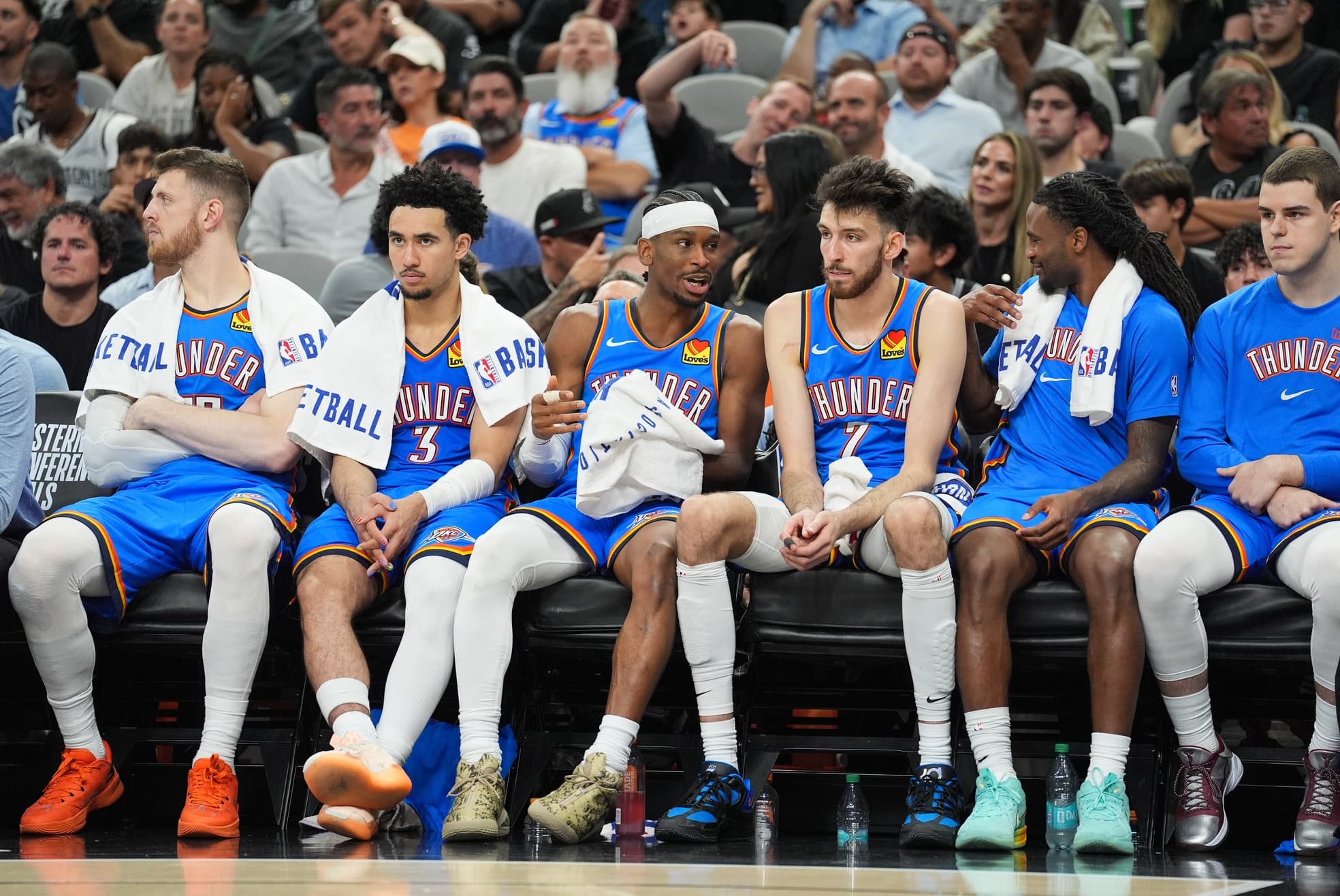
May 24, 2026; San Antonio, Texas, USA; Oklahoma City Thunder guard Shai Gilgeous-Alexander (2) exchanges words with center Chet Holmgren (7) on the bench in the fourth quarter against the San Antonio Spurs during game four of the western conference finals for the 2026 NBA playoffs at Frost Bank Center. Mandatory Credit: Daniel Dunn-Imagn Images
The Oklahoma City Thunder stand at a crossroads. One year ago, they captured their first NBA championship in franchise history during the 2024-2025 season, with Shai Gilgeous-Alexander earning Finals MVP honors after averaging 30.3 points per game in the series. Now, with the 2025 championship crown belonging to the New York Knicks, the Thunder enter the 2026-27 season looking to rebuild from a disappointing 2025-26 campaign that exposed vulnerabilities and tested their championship core.
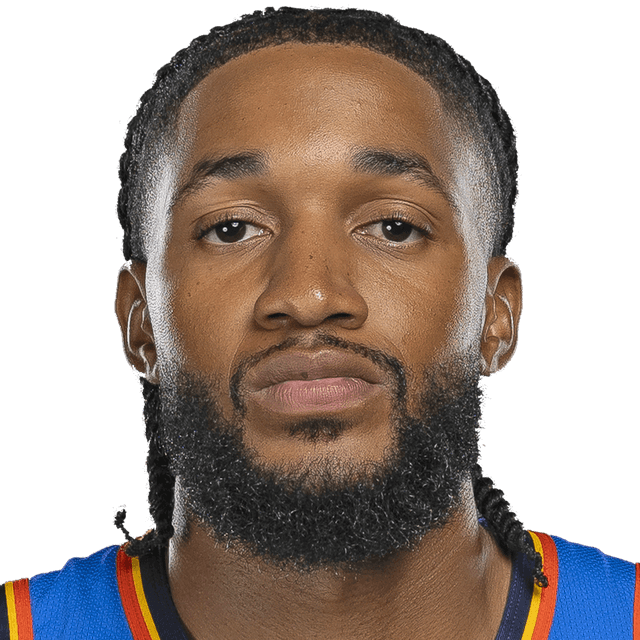
- Position : Point Guard
- Height : 198 cm
- Age : 28 y/o
- Nationality : Canada
- Club : Oklahoma City Thunder
Stats 2026-2027 / NBA Presaison
| PTS | 16.3 | #23 |
|---|---|---|
| REB | 1.3 | #473 |
| AST | 4.7 | #33 |
The 2025-26 season was supposed to be a coronation. After dominating the league as the reigning champions with SGA winning his second consecutive MVP award, Oklahoma City stumbled down the stretch, ultimately falling to the San Antonio Spurs in a heartbreaking Game 7 of the Western Conference Finals. The loss was made more painful by the absence of multiple key contributors. Jalen Williams, the team’s second star, battled a series of injuries throughout the season, while Jared McCain, acquired mid-season to bolster the backcourt, suffered a significant injury during the playoffs that severely limited his availability in the crucial Western Conference Finals matchup. Together, these absences exposed the fragility of even elite rosters.
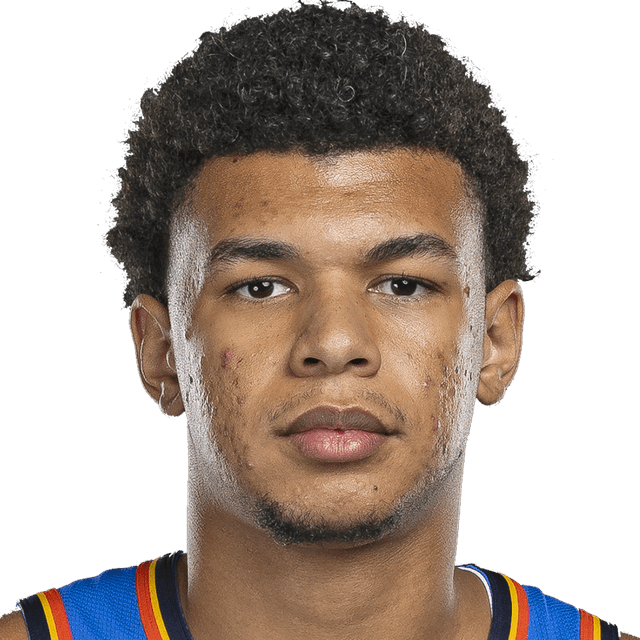
- Position : Shooting Guard, Small Forward
- Height : 196 cm
- Age : 25 y/o
- Nationality : United States
- Club : Oklahoma City Thunder
Stats 2026-2027 / NBA Presaison
| PTS | 16.7 | #19 |
|---|---|---|
| REB | 4.7 | #89 |
| AST | 3.0 | #108 |
A Championship Core Intact, But Tested by Injury
The foundation remains elite. Shai Gilgeous-Alexander continues to anchor everything, averaging 31.1 points per game on 55.3% shooting during the 2025-26 regular season, while adding 6.6 assists and 4.3 rebounds. His two-way dominance — combined with elite efficiency and playmaking — gives OKC a legitimate superstar capable of carrying a team through the playoffs.
But the supporting cast proved fragile in 2025-26. Jalen Williams, the 2024-25 All-NBA wing, was limited to just 33 games after undergoing two wrist surgeries to start the season. When he finally returned in late November, he managed only a handful of healthy weeks before suffering a Grade 1 left hamstring strain on April 22, 2026 — a setback that cost him the final three games of the Western Conference Finals as well multiple weeks during the Season. Williams played only 10 minutes in Game 6 off the bench and was ruled out for the decisive Game 7. For 2026-27, the Thunder must hope that Williams can stay healthy and recapture the form that made him an All-NBA talent. His availability will define the season.
Ajay Mitchell‘s injury during the playoffs proved equally costly. The young guard, who had emerged as a reliable playmaker and primary scoring option off the bench while filling in for the injured Williams, was unable to maintain his impact during the Western Conference Finals run. His absence forced the Thunder to rely more heavily on aging role players and severely limited their offensive versatility and playmaking depth against San Antonio’s suffocating defense. Mitchell’s health status heading into 2026-27 remains a critical question mark, as the Thunder need him to recapture the form that made him such a valuable contributor during the regular season.
- Position : Shooting Guard, Point Guard
- Height : 196 cm
- Age : 24 y/o
- Nationality : Belgium
- Club : Oklahoma City Thunder
Stats 2026-2027 / NBA Presaison
| PTS | 7.0 | #278 |
|---|---|---|
| REB | 2.0 | #339 |
| AST | 3.3 | #72 |
Chet Holmgren, the young center, posted 17.1 points and 8.9 rebounds while shooting 55.7% from the field and 36.2% from 3-points during the regular season — a rare combination of rim protection and floor spacing for a 7-footer. However, his playoff performance against San Antonio exposed vulnerabilities. In the Western Conference Finals, Holmgren averaged just 10.5 points and 8.0 rebounds across four games, significantly outmatched by Victor Wembanyama, who dominated the matchup with 19.3 PPG and 10.7 RPG. The disparity was particularly glaring in Game 7, where Wembanyama’s elite two-way play overwhelmed Holmgren’s defensive presence. For 2026-27, Holmgren must regain confidence and prove that his regular season form translates to playoff success. His ability to contain elite centers and contribute offensively will be critical to OKC’s championship aspirations.
- Position : Power Forward, Center
- Height : 216 cm
- Age : 24 y/o
- Nationality : United States
Isaiah Hartenstein, re-signed to a 3-year, $75 million deal, provides the physicality and rebounding prowess that the Thunder desperately need. In 2025-26, he averaged 9.2 points, 9.4 rebounds, and 3.5 assists in just 24.2 minutes per game, shooting an efficient 62.2% from the field. The team initially declined his option before bringing him back as an unrestricted free agent — a maneuver that created cap flexibility while demonstrating Presti’s commitment to the frontcourt.
- Position : Center
- Height : 213 cm
- Age : 28 y/o
- Nationality : United States
- Club : Oklahoma City Thunder
Stats 2026-2027 / NBA Presaison
| PTS | 3.0 | #480 |
|---|---|---|
| REB | 4.5 | #96 |
| AST | 1.5 | #261 |
Luguentz Dort, one of the NBA’s most reliable perimeter defenders, was locked in via his exercised team option at $17.7 million. In 2025-26, Dort averaged 8.3 points, 3.6 rebounds, 1.2 assists, and 0.9 steals across 69 games, shooting 38.5% from the field. While his offensive production dipped, his defensive intensity remained elite — a critical ingredient in OKC’s playoff formula.
Projected Starting Five and Complete Roster Breakdown
The Thunder’s projected starting lineup for 2026-27 reflects their championship pedigree:
PG: Shai Gilgeous-Alexander (31.1 PPG, 6.6 APG, 55.3% FG, 2025-26 MVP)
SG: Lu Dort (8.3 PPG, 3.6 RPG, elite perimeter defense)
SF: Jalen Williams (17.1 PPG, 5.5 APG, 48.4% FG — if healthy)
PF: Chet Holmgren (17.1 PPG, 8.9 RPG, 55.7% FG, 36.2% 3P)
C: Isaiah Hartenstein (9.2 PPG, 9.4 RPG, 3.5 APG, 62.2% FG)
Bench Contributors:
- Alex Caruso (6.2 PPG, 2.8 RPG, 2.0 APG, 42.3% FG, 56 games in 2025-26) — A two-time NBA champion and two-time All-Defensive selection who provides veteran leadership and perimeter defense off the bench.
- Cason Wallace (8.6 PPG, 3.1 RPG, 2.6 APG, 43.2% FG, 77 games in 2025-26) — The 2023 first-round pick (No. 10) is entering a critical year as he approaches his rookie-scale extension deadline. Wallace showed promise as a two-way guard but must prove he can be a reliable rotation piece.
- Jared McCain (acquired mid-season from Philadelphia for a 2026 first-round pick and three second-round picks) — The 2nd-year guard provides additional backcourt depth and scoring punch. To make room for McCain, OKC traded Ousmane Dieng to Charlotte, freeing up salary to stay within the luxury tax apron. His playoff injury in 2025-26 raised durability concerns heading into 2026-27.
- Kenrich Williams (wing depth, veteran experience) — Re-signed after his team option was declined.
- Nikola Topic (2024 first-round pick, No. 12) — The young guard is recovering from back surgery and remains a developmental prospect.
- Ajay Mitchell (guard) — A reliable 82-game player providing additional backcourt depth.
- Jaylin Williams (center/forward) — A complementary big man offering frontcourt depth.
- Brooks Barnhizer (two-way contract extended) — A project with long-term developmental potential.
Jared McCain (Philadelphia 76ers) - Alex Caruso (Oklahoma City Thunder) · NBA 2025-2026
| Jared McCain | Alex Caruso | |
|---|---|---|
| GP | 67 | 56 |
| PTS | 8.3 | 6.2 |
| REB | 2.1 | 2.8 |
| AST | 1.3 | 1.9 |
| STL | 0.5 | 1.3 |
| BLK | 0.1 | 0.3 |
A Draft Night Built Around Complementary Upside
With limited cap room to operate in free agency, Presti turned to the 2026 draft as his primary tool for roster-building. The Thunder’s three selections reflect a strategic focus on positional fit and developmental potential.
Aday Mara (No. 12, Center, 2.18m, Michigan) — A skilled, high-basketball-IQ big man with elite rim protection instincts and exceptional timing on defense. Mara is an unusually versatile scorer for his size, with advanced passing ability out of the post. His profile closely aligns with Roy Hibbert, one of the league’s greatest rim protectors. At 21 years old, Mara provides long-term frontcourt depth and potential alongside Holmgren and Hartenstein.
Bennett Stirtz (No. 16, Guard, 1.93m, Iowa) — Traded up to secure this prospect, Stirtz led Iowa in scoring, assists, and steals during the 2025-26 college season, averaging 19.8 points, 4.4 assists, and 2.6 rebounds while shooting 35.8% from 3-points. A consummate point guard with excellent basketball IQ and a feel for the game, Stirtz’s primary concerns revolve around his age (22), athleticism, and defensive projection. He fits OKC’s spacing-oriented system and provides backcourt depth.
- Position : Guard
- Height : 193 cm
- Age : 23 y/o
- Nationality : United States
- Club : Oklahoma City Thunder
Stats 2026-2027 / NBA Presaison
| PTS | 14.6 | #42 |
|---|---|---|
| REB | 3.6 | #177 |
| AST | 3.0 | #91 |
Otega Oweh (No. 41, Guard, 1.93m, Kentucky) — An All-SEC Second Team selection who scored in double figures in 35 of Kentucky’s 36 games during the 2025-26 college season, averaging 18.6 points, 4.8 rebounds, 2.7 assists, and 1.8 steals on 46.5% shooting. Oweh is a major draft sleeper as a two-way prospect with high defensive versatility, capable of guarding multiple positions and disrupting passing lanes. He adds backcourt depth and two-way potential in the second round.
Aaron Wiggins was traded to the Atlanta Hawks and Isaiah Joe was sent to the Detroit Pistons, clearing roster spots and creating room for the incoming class.
Financial Reality and Cap Constraints
The Thunder’s salary cap situation is tight heading into 2026-27. With Jalen Williams earning approximately $33-36 million annually and Chet Holmgren at $41.24 million, Oklahoma City is currently over the cap by a substantial margin. The total payroll hovers around $250 million, placing the organization well into luxury tax territory. This means OKC has virtually no financial flexibility to add veteran help mid-season or pursue additional free agents.
The cap crunch also explains the reliance on draft picks and internal development. Rather than spending in free agency, Presti invested in three draft picks within the first two rounds, betting that young talent can develop alongside the established core. It’s a calculated gamble — one that assumes Holmgren, Williams, and the newly drafted class will make meaningful strides during the 2026-2027 season.
The Cason Wallace Extension: A Critical Negotiation
One critical storyline overshadows the 2026 offseason: Cason Wallace’s rookie-scale extension. The young guard, who has a $7.4 million team option for 2026-27 that has already been picked up, is eligible for a rookie-scale extension through October 19, 2026. This negotiation will be OKC’s first real contract discussion with a homegrown young player in years, and the outcome could shape the team’s financial flexibility for the next half-decade.
- Position : Shooting Guard
- Height : 193 cm
- Age : 22 y/o
- Nationality : United States
- Club : Oklahoma City Thunder
Stats 2026-2027 / NBA Presaison
| PTS | 7.0 | #284 |
|---|---|---|
| REB | 3.0 | #227 |
| AST | 3.5 | #66 |
Wallace averaged 8.6 points, 3.1 rebounds, and 2.6 assists across 77 games in 2025-26, shooting 43.2% from the field and 35.1% from 3-points. While his production remains modest, his two-way potential and fit in Daigneault’s system suggest he could command a significant extension. If Wallace and the Thunder reach an agreement on a long-term deal, it will lock in a promising young talent — but it will also consume additional cap space. If negotiations stall, Wallace could become a restricted free agent in summer 2027, creating additional uncertainty. Presti’s handling of this negotiation will be a key indicator of how aggressively the team plans to commit resources to its young core.
Potential Trade Pieces and Mid-Season Flexibility
Despite exercising Lu Dort’s $17.7 million team option, Presti has strategically positioned the Thunder to maintain mid-season flexibility for 2026-27. Dort’s expiring contract — combined with his elite perimeter defense — makes him an attractive asset in potential trade scenarios. Multiple NBA teams, including the Los Angeles Lakers, have already inquired about Dort’s availability, signaling that contenders view him as a valuable piece worth pursuing at the trade deadline.
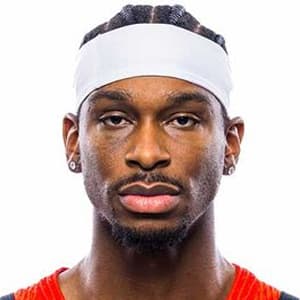
- Position : Shooting Guard, Small Forward
- Height : 194 cm
- Age : 27 y/o
- Nationality : Canada
- Club : Atlanta Hawks
Stats 2026-2027 / NBA Presaison
| PTS | 7.0 | #290 |
|---|---|---|
| REB | 6.0 | #44 |
| AST | 2.0 | #212 |
Dort represents Presti’s hedge bet. By keeping him on the roster, the Thunder gain a reliable two-way contributor for the regular season while retaining the option to move him before the February deadline if a compelling opportunity emerges. An expiring contract of Dort’s caliber could be packaged with draft assets to acquire a missing piece — whether a scoring punch, additional frontcourt depth, or another perimeter creator. Presti has a history of executing deadline trades that reshape rosters, and Dort’s presence gives him the financial leverage to do so again if circumstances warrant it.
Beyond Dort, Kenrich Williams’ expiring contract also provides flexibility. The decision to exercise Dort’s option rather than decline it signals confidence in the core, but it also leaves the door open for aggressive mid-season maneuvering. In a crowded Western Conference, that flexibility could prove invaluable.
Mark Daigneault’s Coaching Philosophy and System Fit
In his seventh season as head coach, Mark Daigneault continues to refine a system built on defensive intensity, ball movement, and collective effort. His approach prioritizes defensive versatility and spacing, which aligns perfectly with the Thunder’s roster construction. Daigneault has earned respect around the league for his ability to develop young talent and maximize the potential of role players — skills that will be essential as OKC integrates multiple new faces for 2026-27.
The system’s emphasis on perimeter defense and three-point shooting suits this roster perfectly. Holmgren’s floor-spacing ability, Dort’s lockdown defense, and SGA’s playmaking all thrive in Daigneault’s framework. The coach’s track record suggests he can extract maximum value from the drafted prospects, particularly Mara, who will need time to develop but has the tools to eventually anchor the frontcourt.
The Road Back to the Finals: Can the Thunder Win It Back?
The 2026-2027 season represents a pivotal moment for Oklahoma City. The Thunder must prove that last year’s championship run was not a one-off achievement, but rather the foundation of a sustained contender. The Western Conference has only grown more competitive — San Antonio’s emergence as a Finals threat, Denver’s continued dominance, and the Lakers’ perpetual championship ambitions ensure that the margin for error is razor-thin.
For OKC to return to the Finals, health must finally break their way. Jalen Williams must remain on the court for a full season after his injury-plagued 2025-26 campaign. Ajay Mitchell must prove durable after his playoff setback. Chet Holmgren must reclaim the form that made him a legitimate two-way force before facing Wembanyama’s suffocating defense. The young draft class — Mara, Stirtz, and Oweh — must accelerate their development timelines and contribute meaningfully in their first season.
Yet even with health, questions linger. Can Presti’s salary cap constraints limit his ability to address weaknesses mid-season? Will the reliance on internal development prove sufficient against teams with more financial flexibility? And perhaps most critically: can SGA, now entering his prime years, carry a team with a fragile supporting cast through a grueling playoff gauntlet?
Sam Presti has earned the benefit of the doubt. His construction of this roster, his championship-winning decisions during the 2024-25 title run, and his ability to navigate the salary cap have all been validated. But in a loaded conference, the 2026-2027 season will test whether continuity, internal development, mid-season flexibility, and the health of a fragile supporting cast are enough to push Oklahoma City back to the Finals and win back the crown. Presti doesn’t have to make a move — but if the right opportunity presents itself, his financial tools and expiring contracts give him the option to do so. The Thunder’s championship window remains open, but time is no longer on their side.













Comments (0)