
EuroLeague Final Four 2026: How American Depth and 3-Point Spacing Cracked the Championship Code
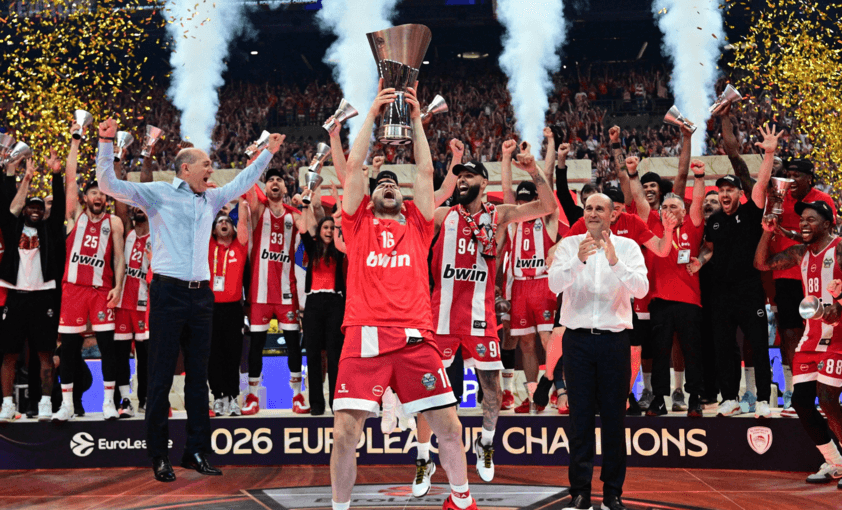
Olympiacos wins 4th EuroLeague title Photo Credit: Olympiacos B.C.
The 2026 EuroLeague Final Four wasn’t really about Olympiacos Piraeus versus Fenerbahce, or Valencia against Real Madrid. It was about floor spacing, roster construction philosophy, and a quiet revolution in how elite European clubs now think about American player deployment. Olympiacos won the championship not despite having four meaningful American contributors, but because of the specific architectural advantages those players created.
Consider the problem Olympiacos faced: opponents can’t defend multiple 3-point threats simultaneously. This sounds simple—almost tautological—but it’s the fundamental mathematical reality that has reshaped basketball at every level. Olympiacos understood this with uncommon clarity. By inserting Alec Peters, Tyler Dorsey, Thomas Walkup, and Evan Fournier into its rotation, the Greeks forced opposing defenses into a cascading series of impossible choices.
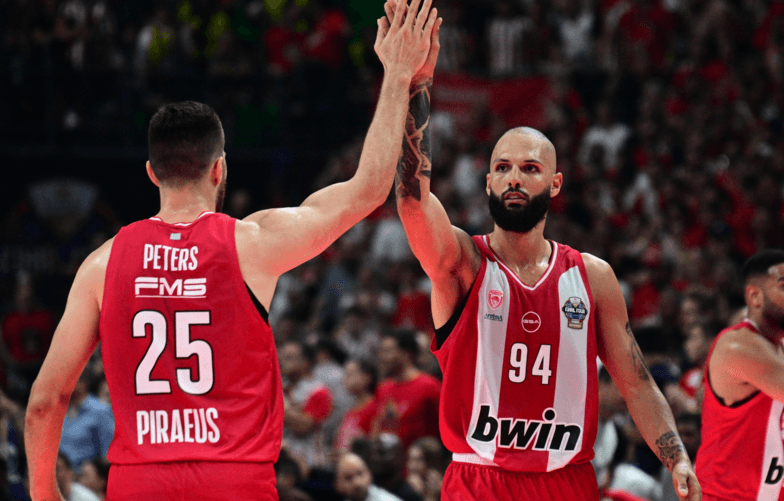
The Peters Phenomenon: Perfect Efficiency as a Design Element
Against Fenerbahce in the semi-final, Peters didn’t just score 17 points on 7-for-7 shooting—a line so pristine it almost seems fictional. He scored them in exactly 18 minutes, which is the real story. Olympiacos could rotate him out when Fenerbahce adjusted, reinsert him later when defensive assignments reset. This is the luxury of multiple scorers: you can manage minutes and leverage rest as a strategic variable rather than a necessity.
Peters’ 4-for-4 3-point performance wasn’t an anomaly born of hot shooting. It reflected Olympiacos’ system: catch-and-shoot opportunities generated by Walkup’s facilitating and off-ball screening. Peters doesn’t create his own shot in high-leverage moments the way a primary scorer must. He exists within a constructed ecosystem designed to get him clean looks. That Fenerbahce—a team with Talen Horton-Tucker and Wade Baldwin IV—couldn’t sufficiently contest these looks is instructive. Horton-Tucker and Baldwin are NBA-caliber players, yet their presence couldn’t overcome the systemic problem of perimeter-oriented spacing.
In the final against Real Madrid, Peters modulated his role slightly (16 points in 20 minutes, still 5-for-6), proving the depth of his value. He wasn’t a one-note scorer. He could operate in different volumes, different tempos, against different coverages.
Walkup’s Geometry: How a 40% Shooter Becomes a Spacing Asset
Thomas Walkup’s statistical line in the semi-final—2 points, 5 assists, 5 rebounds in 26 minutes—looks pedestrian until you understand what he was actually doing. He was functioning as a secondary playmaker whose very existence on the floor demanded defensive respect. Walkup is a competent 3-point threat (though not a high-volume one). Opponents cannot leave him unattended because he can make you pay from distance. This forces guards toward him, opening driving lanes for teammates.
In the final, Walkup’s perfect 3-for-3 shooting (100% from the field overall) becomes less surprising when you recognize he’s not hunting volume. He’s taking the shots the defense gives him—a much higher-quality diet than volume scorers consume. His 10 points in 23 minutes, paired with 2 assists, represents a player functioning optimally within a larger system. This is underappreciated: Walkup isn’t trying to win a scoring title. He’s trying to run an offense with surgical precision and make the right play 95% of the time. The 3-for-3 shooting reflects that discipline.
The Fournier Wildcard: Veteran Scoring Pop as Closing Mechanism
Evan Fournier’s 20 points off the bench in the final—especially his perfect 5-for-5 free-throw shooting in crunch time—represents something increasingly rare in basketball: a high-usage player who doesn’t require high shot volume to be effective. Fournier attempted only 12 shots yet produced 20 points, a 1.67 points-per-attempt ratio that most playoff teams would kill for.
This matters because championship basketball is about margin optimization in the final six minutes. Fournier’s ability to attack the rim, draw fouls, and convert from the stripe removed a variable from Olympiacos’ offense during Real Madrid’s desperate closing push. Real Madrid couldn’t intentionally foul him without consequence. This is the kind of clutch-time asymmetry that decides championships.
The Valencia Counterargument: Spacing Without Depth
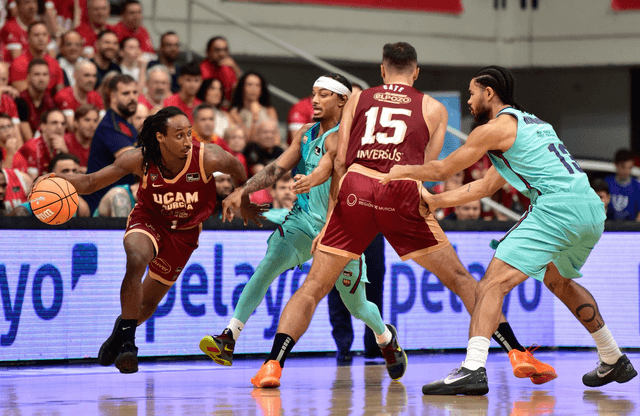
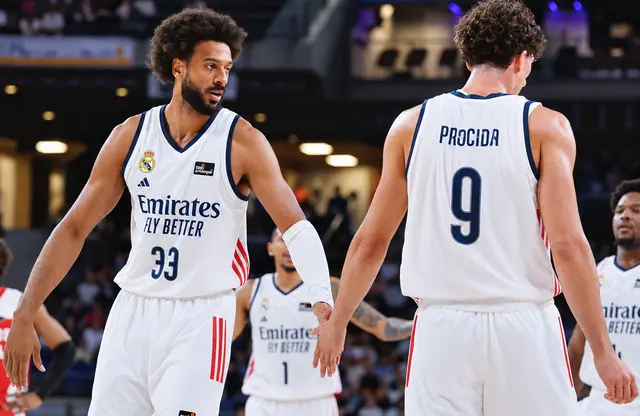
Valencia’s semi-final loss to Real Madrid (90-105) is instructive because it shows what happens when you have spacing assets (Braxton Key, Kameron Taylor) without sufficient roster depth to generate multiple simultaneous threats. Key (13 points on 6-for-9) and Taylor (11 points, 4 assists) both played well. Key’s 71.4% 2-point conversion and 50% 3-point shooting are league-leading numbers. Yet Valencia lost by 15.
The problem: Key and Taylor had to do too much. There was no third or fourth American scorer to redistribute defensive attention. Real Madrid could focus its defensive intensity on one or two players in critical moments, essentially removing Valencia’s advantage. Olympiacos, by contrast, could lose one player and still field four competent scorers and playmakers.
The Philosophical Subtext: American Players as Roster Architecture
What’s happening here transcends individual performance. The 2026 Final Four revealed that elite European clubs now view American recruitment not as luxury or depth but as foundational infrastructure. American players—particularly those with college pedigree and NBA development—bring specific skill sets: 3-point shooting at creation and catch-and-shoot opportunities, pick-and-roll navigation, defensive versatility, and English-language comfort that simplifies coaching.
These aren’t coincidences. They reflect how American basketball culture has evolved to emphasize perimeter skill and offensive flexibility. A 6-foot-10 American forward is more likely to possess a 3-point shot than a 6-foot-10 European forward. A 6-foot-4 American guard is more likely to function as a secondary playmaker. These statistical distributions matter when you’re building a roster.
Olympiacos exploited this by essentially acquiring a second team’s worth of perimeter scorers and facilitators. Peters, Dorsey, and Walkup could all hurt you from 3-point range. All three could playmake. None required high-volume usage to be effective. Real Madrid’s aging core—relying on more traditional European positional basketball—couldn’t match this modern structural advantage.
The Closing Argument: Spacing and Defensive Mathematics
In the final minutes of the championship game, with Olympiacos ahead 92-85, Real Madrid’s defenders faced an impossible math problem: defending Peters, Dorsey, Walkup, and Fournier simultaneously. You cannot overhelp without leaving someone open. You cannot sag without conceding 3-point shooting. Olympiacos had solved the basketball equation through roster construction rather than any particular innovation in play design.
This is how championships are won in 2026 EuroLeague basketball: not through individual brilliance alone, but through systematic roster construction that creates defensive impossibilities. Olympiacos’ American-powered depth was that impossibility made manifest.
















Comments (0)