


Gianmarco Pozzecco, former ASVEL coach, speaks out: « I wouldn’t change for Tony Parker »
Speaking to French journalists from Euro Insiders, Italian Galatasaray Istanbul coach Gianmarco Pozzecco opened up about his time at ASVEL and his relationship with Tony Parker.
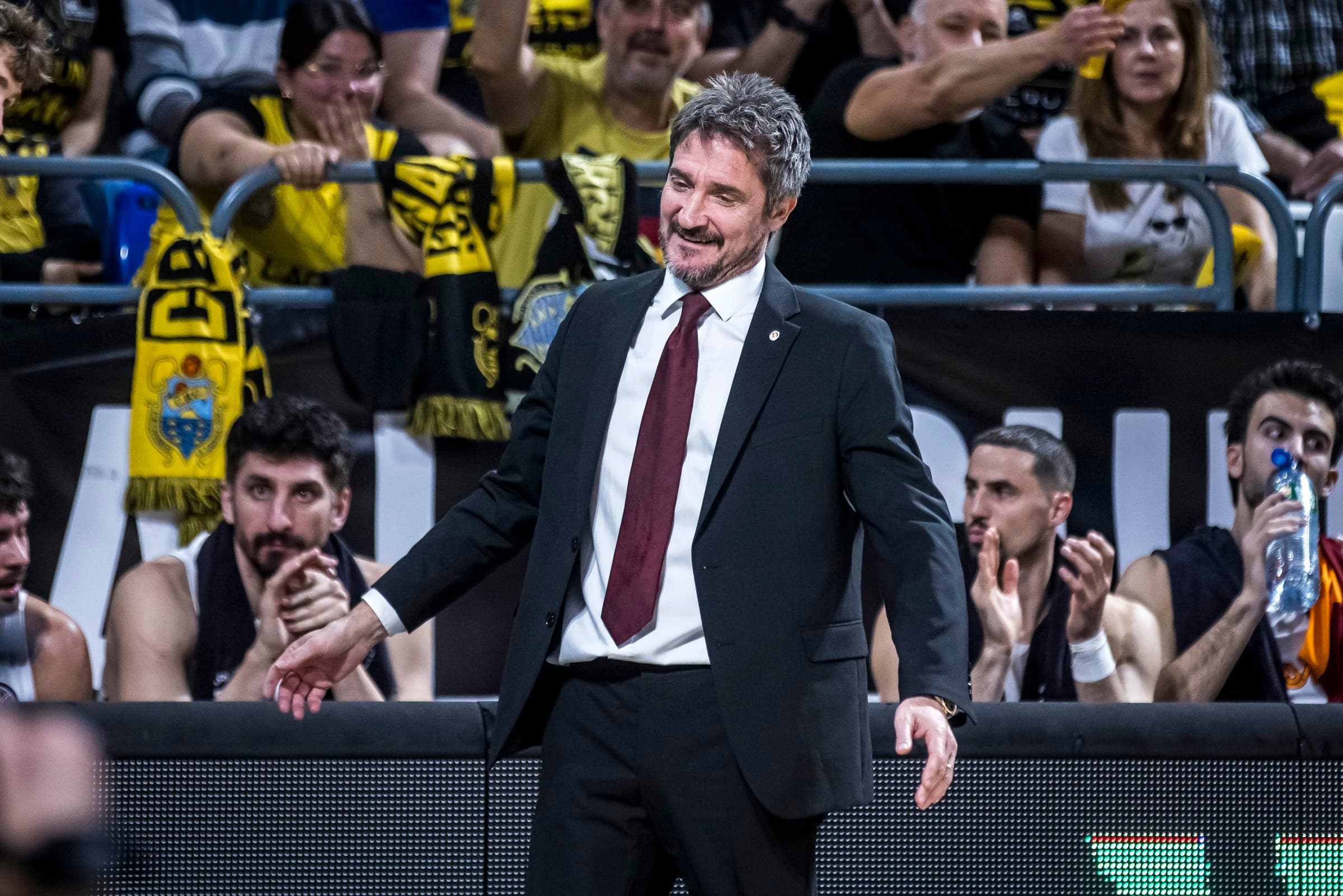
Photo Credit : FIBA
The showman, Gianmarco Pozzecco has long been one of basketball’s most magnetic personalities—equal parts theater and intensity, especially behind the microphone. Euro Insiders’ French reporters, Alexandre Maticiuc and Benedikt Maukner, caught up with him in Istanbul before Galatasaray bowed out in the Basketball Champions League quarterfinals. What followed was a wide-ranging, very Pozzecco conversation—touching on his winding coaching journey, his view of the European basketball ecosystem, his rocky spell at ASVEL in 2023–24, and his relationship with Tony Parker.
Why become a coach?
Gianmarco Pozzecco didn’t exactly feel some grand calling to coach. What pulled him in was simpler—and more dangerous: winning. “Coaching is like a casino,” he says. “Once you start winning, you can’t stop.” Two early seasons on the bench were enough to hook him after a playing career that turned him into a cult figure in Italy—fiery, unpredictable, sometimes chaotic, and yes, the pink hair. But he’s clear about the trade-off: coaching hits differently. “You suffer much more as a coach than as a player,” he admits, noting he doesn’t plan to do this forever, with family time looming as a priority down the line.
For Pozzecco, it’s all about the rush and the relationships. The adrenaline of competition, the emotional connection with his players—that’s the fuel. It’s also what makes him such an outlier on the European scene, a coach who operates as much on instinct and feel as structure. But he’s not blind to the volatility of the job. “Life is great when you’re in a good moment as a coach,” he says, before quickly grounding it: “If you had asked me this two weeks ago, when we were playing well, my answers would’ve been different.”
Antoine Rigaudeau, the player you pick with no hesitation « eyes closed »
When asked to name the ultimate plug-and-play player, Gianmarco Pozzecco didn’t blink. His answer: Antoine Rigaudeau. The former Virtus Bologna guard, in Pozzecco’s view, is one of the most underrated players Europe has produced—a do-it-all connector who fits anywhere, anytime. “He’s the one guy you take without thinking and drop into any team in the world,” Pozzecco says. “You need a 1, a 2, a 3, a shooter, a passer—everything. That’s Rigaudeau.”
The memory that still sticks with him says a lot. Rigaudeau, then with Élan Béarnais Pau-Orthez, facing Virtus Bologna, delivering 16 points in overtime in a game Pozzecco clearly hasn’t forgotten. It’s the kind of performance that captures exactly what he means—quiet dominance, total versatility, no wasted motion.
And then there’s the twist, very Pozzecco. In his eyes, Rigaudeau might be the rare case of a player who actually prefers coaching to playing—a detail that somehow makes him even more fascinating, especially coming from a former rival who clearly still sees the game through that lens.
Has basketball become too serious?
Gianmarco Pozzecco is one of those voices pushing back on where European basketball is heading. In his view, something has been lost in the sport’s push toward hyper-professionalism. He doesn’t hide behind clichés either—he’ll tell you straight up he was a champion on and off the court, even drawing a comparison to Dennis Rodman. For Pozzecco, the issue isn’t discipline—it’s connection. “Players have become too professional,” he says. “At 25, you can’t forget—after a win, sometimes you go out, have a few beers.” It’s less about partying, more about the human moments that actually build teams.
That shift, in his eyes, goes beyond the locker room. Today’s players are pulled in every direction—sponsors, media obligations, social platforms—all competing for attention that used to be locked on the game itself. “We were focused only on basketball,” he says. “Now there are too many things… too many things to then go on the court and really play.” It’s not nostalgia for the sake of it—it’s a belief that something essential gets diluted when the game stops being the center.
And when the conversation turns to the broader evolution of the sport, Pozzecco lands in a familiar place—right alongside Šarūnas Jasikevičius. Yes, European basketball is drifting toward the NBA model. That’s inevitable. But he draws a hard line when it comes to identity. “In Europe,” he says bluntly, “we don’t give a fuck about show. We want to see you win.”
ASVEL and Tony Parker: words that sting
The Lyon chapter remains a painful one. Pozzecco acknowledges that he wasn’t able to give his all in every game given the relentless schedule, and admits a management mistake in cutting a player upon his arrival that he shouldn’t have let go given what followed. After being fired, he sent a thank-you message to Tony Parker. The two men had worked together for two months, but he never received a reply. Worse, he soon learned that the ASVEL president had made harsh comments about him in the French press. « I had a good relationship with him. He never complained to me directly. »
Yet Pozzecco refuses to hold a lasting grudge: « That’s just who I am: I want to have a good relationship with everyone involved in the club, and I’ll keep doing that. Even if you disagree with me, I won’t change for Tony Parker. »
Polonara’s heartbreaking journey, raw emotion
Galatasaray: a tough end to the season, an ambitious future
On Wednesday night, Galatasaray were eliminated from the BCL by Tenerife in a decisive 99-59 loss in the third quarterfinal game. A heavy defeat that echoes Pozzecco’s candid words in the interview: « We’re missing something this year. » The coach had identified his team’s shortcomings — consistency, post-up presence, defensive solidity — while expressing his belief in the project in the medium term. « We’ve already built the team for next season, and I’m very excited to finish this season as well as possible. I think we have everything to build a really solid team. »
On the EuroLeague scene, he offered a clear-cut prediction: « In my opinion, Olympiacos will win the EuroLeague. But Fenerbahçe is currently the best team in Europe. » As for the best coach in the competition, he doesn’t hesitate: « Sarunas (Jasikevičius) is the best coach right now. »






Comments (0)