

JL Bourg: the secrets that propelled a club from ELITE 2 to the top of French and European basketball
JL Bourg has established itself as a benchmark in France in recent years, with a regular presence in the Betclic ELITE Top 4 and two EuroCup finals in three seasons. A structured, long-term model, detailed by its general manager Fabrice Pacquelet.
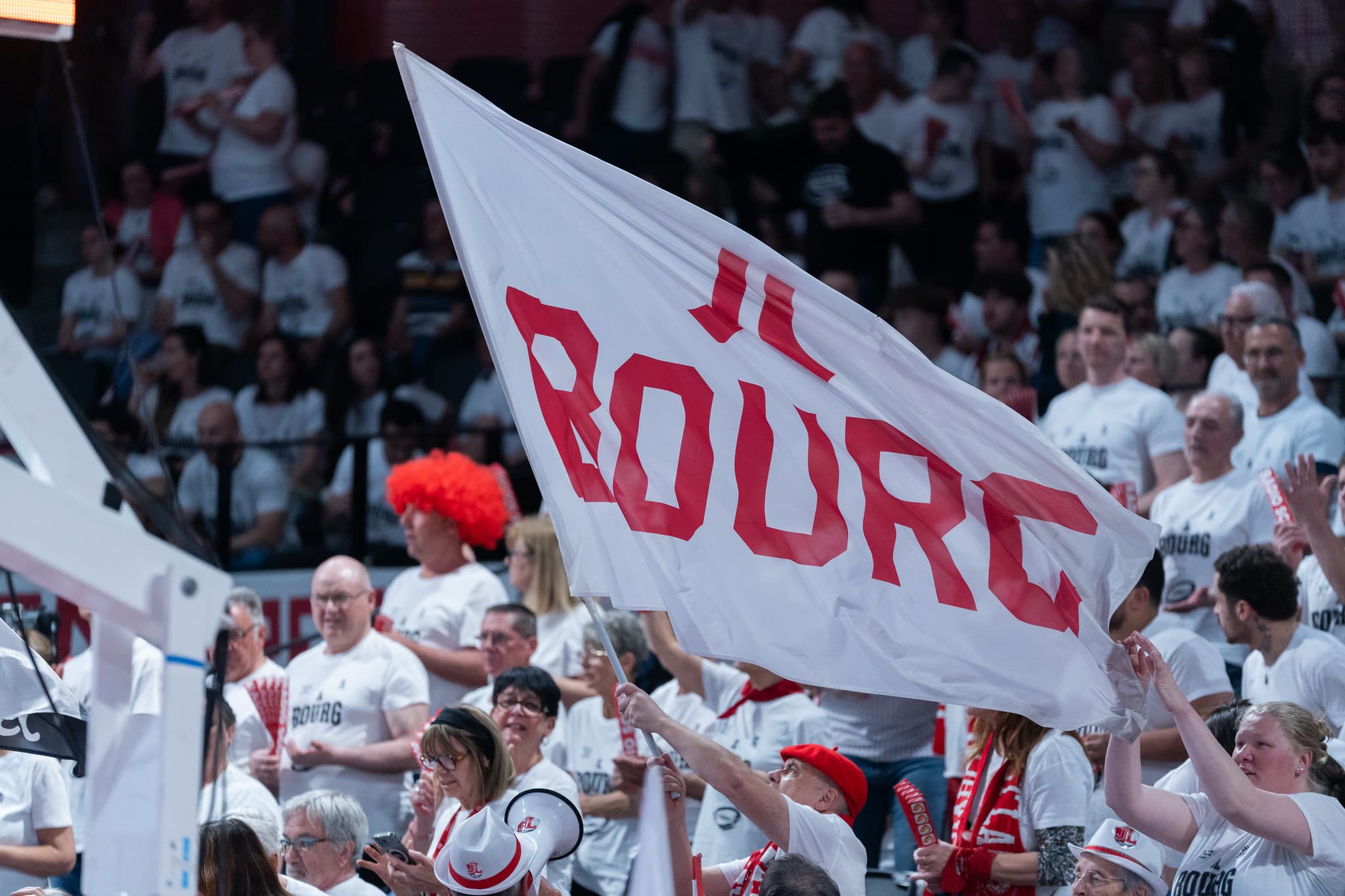
Photo Credit : Cécile Thomas
JL Bourg is no longer a surprise. Firmly established at the highest level of French basketball, the Bourg-en-Bresse club has strung together impressive results, with several consecutive appearances in the final four of the Betclic ELITE and two EuroCup finals in three seasons.
For a club from a metropolitan area of around 40,000 inhabitants, without the economic power of major cities, this trajectory raises questions. Yet it can be explained by a gradual, methodical construction process that began more than ten years ago.
A structure built from 2011
The arrival of Fabrice Pacquelet in 2011 marked a turning point in the club’s recent history. At the time, the priority was not immediate performance, but rather building a solid structure.
« The goal was to build a sustainable club, not one dependent solely on sporting results, » explained the general manager a few hours after qualifying for the 2026 EuroCup final, during the second webinar of the Basketball Hub.
This initial positioning shaped the entire development of JL Bourg. The opening of the Equinox arena, a few years later, was part of this long-term vision, with a clear ambition: to create a facility capable of supporting sustainable growth.
Early on, the club drew inspiration from North American models, incorporating a dimension that was still largely undeveloped in France.
« We integrated the concept of sportainment. The idea is that people come to live an experience, not just watch a game. »
This defining choice now allows the club to maintain a consistently high attendance rate, regardless of short-term sporting results.
Breaking free from dependence on results
At the heart of the Bourg project is a key idea: decoupling economic performance from sporting performance as much as possible.
« We built a model where the club can continue to grow even when results fluctuate, » insists Fabrice Pacquelet.
In an environment where many clubs remain dependent on their results to generate revenue and attractiveness, this approach stands out. It is based on a solid internal structure, with a clear separation between activities related to the court and those related to economic development.
Today, JL Bourg has around 45 employees, a testament to the high level of professionalization for a club of this size.
An economic model built on diversification
JL Bourg’s economic development rests on a simple principle: multiplying revenue streams to limit risk. With more than 400 partners, the club has chosen not to rely on a single major donor. « The idea was to spread the risk, » the executive summarizes.
This strategy ensures financial stability while also creating a strong local economic network around the club. It is accompanied by a significant share of private resources, which now account for nearly 87% of the overall budget, estimated at around 8 million euros.
In the French landscape, this level of financial independence is remarkable — even a model that extends well beyond professional basketball clubs.
The 1055 complex, a symbol of a new dimension
The real turning point in the Bourg model came with the development of the 1055 complex. Combining leisure, dining and a community hub, this project goes far beyond the traditional scope of a sports club. It has become a major economic pillar.
« The 1055 has become our number one partner, » confirms Fabrice Pacquelet.
The complex generates revenue at multiple levels: sponsorship, commercial activity and dividend distribution. JL Bourg holds a 46% stake in it, allowing the club to directly capture part of the value created.
This type of diversification remains rare in French basketball.
An ecosystem that goes beyond the court
The club’s strategy is not limited to simple economic diversification. It is part of a broader vision aimed at making JL Bourg a central player in its local community.
The SANA project, a 2,000 m² sports-health center located near the Equinox arena, illustrates this ambition.
« The idea is to serve both the professional team and the general public, » explains the general manager.
At the same time, the club organizes events that go beyond sports, such as leadership forums and a jobs fair that attracted several thousand attendees. These initiatives help broaden the club’s audience and strengthen its local roots.
Athletic appeal built differently
On the sporting side, JL Bourg must work within significant constraints, particularly when it comes to recruiting for the professional team. The club faces a high turnover rate, with nearly 90% of the roster renewed in 2025.
« We have to compensate through our environment and our attractiveness, » emphasizes Fabrice Pacquelet, who also points to the development academy as an example.
To differentiate itself, JL Bourg has developed a specific youth development strategy, including the creation of a « point guard school. » This specialization allows the club to attract targeted profiles and increase its visibility.
EuroCup as an accelerator
Regular participation in the EuroCup has also played a key role in the club’s rise.
Recognized as the sole second-tier European competition until the BCL gained prominence and began competing with it, the EuroCup remains an important driver of attractiveness, as it is still seen as a gateway to the EuroLeague for many players and their agents. « It’s a very attractive competition for players, » explains the executive.
JL Bourg’s performances, with two finals in three seasons, have strengthened its standing on the European stage and made recruitment easier.
Between European ambition and financial caution
The question of a possible move to the EuroLeague now naturally arises. But the club is proceeding carefully.
« It’s a dream, but never at the expense of the club’s sustainability, » cautions Fabrice Pacquelet.
This caution reflects the DNA of the Bourg project: controlled growth built on solid foundations, rather than a race for immediate performance… though the glass ceiling remains difficult to break through.
A model that challenges French basketball
In a landscape where many clubs are still seeking financial equilibrium, JL Bourg’s trajectory stands out as a reference point.
Its ability to combine sporting performance, financial solidity and innovation makes it a unique case study.
The question remains whether this model, patiently built over more than ten years, can be replicated elsewhere… or whether it remains, for now, an exception in French basketball — even if it already appears to have inspired others, such as ADA Blois and, to a lesser extent, JDA Dijon.



Gabriel Pantel-Jouve is the founder and editor-in-chief of BeBasket, which he has been running since 2010 (formerly known as Catch & Shoot). Having studied at the École Publique de Journalisme de Tours and two universities in North America, he has developed his expertise in French basketball, from the National League to amateur divisions, over the past 20 years. Alongside this, he is also involved in the development of clubs in the Montpellier area.
Comments (0)