
Interview with François Lamy (Bourg) on the future of European basketball: “My fear is that we are creating a speculative bubble”
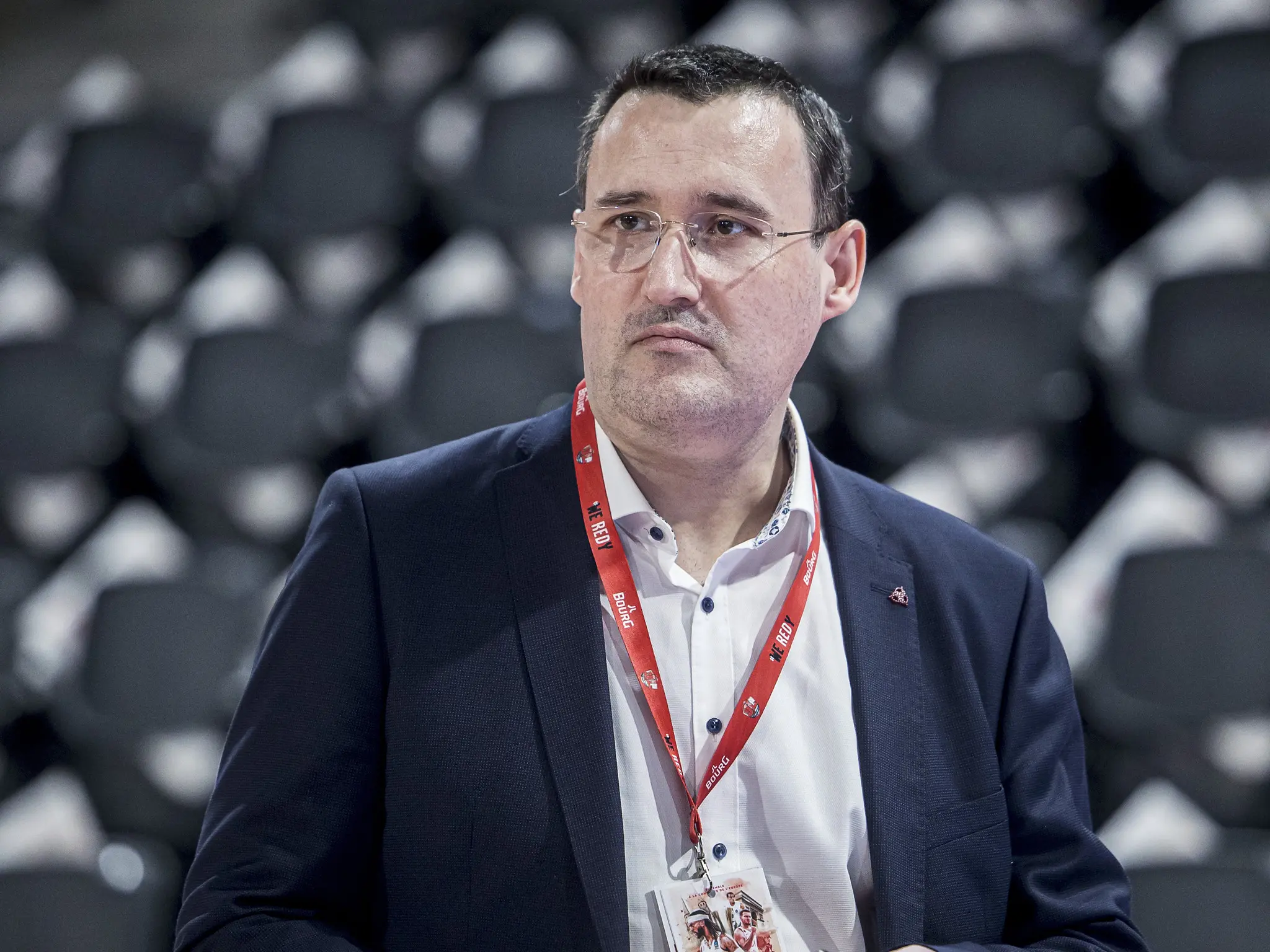
European basketball is entering a period of upheaval whose consequences go far beyond the court. Salary inflation, a growing number of investors, the NBA Europe project, the evolution of EuroLeague, the fragility of some economic models: François Lamy is closely watching a transformation that directly affects the daily life of French clubs.
The general sports manager of JL Bourg-en-Bresse also sees his club facing a very concrete situation. A few weeks before the season restarts, Bourg still doesn’t know for sure whether it will have to start its season in Monaco or in Saint-Quentin. A consequence of the Monaco case that the Bourg executive considers far more worrying than its logistical implications alone.
In an interview granted to BeBasket, François Lamy also details JL Bourg’s recruitment method, whose roster has once again been built very early, before laying out his vision of a European basketball gradually taken over by a logic of financialization.
Why JL Bourg still wraps up its recruitment very early
While several French clubs waited a good part of the summer to finalize their roster, JL Bourg had finished its recruitment as early as June 20th. A policy fully embraced by François Lamy, who prefers to quickly convince players who are genuinely interested in the Bourg project rather than wait in hopes of benefiting from a price drop.
“I don’t want us to wait for a player to have turned down five offers and finally decide in July to come to Bourg as plan F. JL Bourg remains a small club in terms of resources, with fairly limited appeal on an international market, so we have to work differently.”
The club thus seeks to compensate for its financial resources through in-depth work on its sporting project and its presentation to targeted players.
“We try to sell a project, which is recalibrated every year since we renew a lot every summer. We try to work on it a lot, to make it credible. We have created many tools both for analysis and for presenting this project, and the feedback has been rather very positive.”
This anticipation also has an administrative advantage. With a final file wrapped up on June 20th, Bourg was able to quickly start the necessary procedures for players from outside the Schengen area.
François Lamy points out, however, that obtaining visas also depends on the players’ situation: participation in the Summer League, national team duty, or vacation can push back their appointments. In the United States, the process is complicated by the requirement to appear in person at one of the ten available offices across the entire country.
Visas shouldn’t steer clubs away from the American market
Despite these growing constraints, François Lamy doesn’t believe in a radical change in how French clubs recruit, particularly at the expense of American players.
“All the constraints growing year by year, even month by month, will change recruitment habits, but not specifically on this topic of residence permits.”
The former agent notes above all a professionalization of French structures, with more staff dedicated to sporting construction and administrative matters.
“French clubs in general are starting to become very sharp in managing all the issues that come our way. The problem of resources in French basketball is concentrated on the financial side; otherwise, we have a large majority of clubs that work extremely well.”
According to him, the American talent pool remains too large to be neglected, especially since the number of top-level French players playing abroad keeps increasing.
François Lamy fears a “speculative bubble” in European basketball
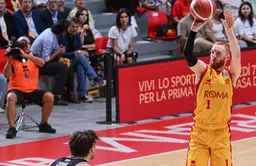
The deepest transformation, however, is happening at the European level. François Lamy observes the spectacular increase in resources of several EuroCup teams, a competition won by Bourg last spring. He notably cites the two Rome clubs, the two Thessaloniki teams, Bahçeşehir, Hapoel Jerusalem, Buducnost Podgorica, Naples, and London. Several of these organizations, in his view, are preparing a bid for the future franchised EuroLeague or, in Rome’s case, for the NBA Europe project. “For several of them, sporting payrolls are now between 5 and 10 million euros net for players.”
François Lamy directly links this inflation to the competition taking shape between EuroLeague and NBA Europe.
“With the tectonic shift between EuroLeague and NBA Europe, there is a considerable inflow of capital from investors who see a logic of financial valuation of clubs taking shape. That’s the model NBA Europe has presented, and it’s the model EuroLeague is announcing it will follow.”
An evolution whose economic foundations he nonetheless questions. According to the executive, the American model cannot necessarily be reproduced in the European market, where sport doesn’t generate the same levels of consumption.
“Before shifting from a logic theoretically based on generating revenue to a logic of financializing a product, we need to make sure that this product corresponds to a consumption value.”
And the former assistant GM of Zalgiris Kaunas expresses a very clear concern:
“My fear is indeed that we are creating a speculative bubble, and like any bubble, if it is confronted with a consumption reality that squeezes it, it ends up bursting.”
The situation in Monaco: “Personally, I’m handling it very badly”
This question of the economic soundness of clubs inevitably brings us back to Monaco. A few weeks before the season restarts, the uncertainty surrounding the Roca Team’s participation in Betclic ELITE has direct consequences for Saint-Quentin and for the entire league. JL Bourg is particularly affected since it will have to travel to one of these two clubs for the first matchday.
“Personally, I’m handling it very badly, because it’s the culmination of a situation that has been going on since 2023 and that was set aside for too long.”
François Lamy specifies that it is not up to him to determine the regularity of Monaco’s practices, this responsibility falling to the relevant authorities. He believes, however, that the current situation was foreseeable.
“I am very attached to respecting the rule of law, and I have the feeling that the financial and reputational benefit of certain sporting results may have, for some stakeholders, created an opportunity bias that delayed a necessary overhaul.”
In his view, the uncertainty surrounding the schedule remains secondary.
“The logistical organizational concerns remain secondary compared to the damage this case will cause, over time, to French professional basketball as a whole.”
An initiative involving general managers and sports directors
Faced with the situation, François Lamy reached out to the sports executives of the Betclic ELITE clubs concerned, without directly contacting Saint-Quentin due to its particular situation.
“I checked whether they thought a bit like me or whether I was the only one outraged that in mid-August, there wasn’t an organized statement raising the questions that need to be raised regarding this absurdity.”
The JL Bourg manager explains that he notably asked his counterparts about the possible legal consequences of Monaco remaining in Betclic ELITE. He also mentions the provisions of the law of August 3, 2026, which establishes sporting uncertainty as a fundamental principle of professional sport and equal opportunity among competitors.
“All the SDs (sports directors) and GMs responded very positively to this initiative, and it was passed on to the club presidents, but that’s all as far as I’m concerned, and I don’t know what became of it.”
François Lamy points out that sports directors and general managers do not have a specific representative body. The decision on any possible collective action therefore rests with the club presidents.
Strengthening the control of international financial flows
To prevent a similar situation from happening again, the Breton believes that financial oversight still needs to improve, particularly regarding international capital movements. “Not all countries are on equal footing when it comes to compliance obligations, particularly regarding the traceability and origin of funds.”
He thus distinguishes between the constraints imposed on French clubs, integrated into the national banking system, and those that may surround certain cross-border flows.
“Strengthening should therefore mainly focus on controlling cross-border flows and harmonizing compliance standards between jurisdictions. That, in my opinion, is where the real room for improvement lies.”
“I don’t think it’s conceivable” that another club could become champion
In such a shifting environment, JL Bourg’s stability could appear as a competitive advantage. François Lamy acknowledges that it allows the club to optimize its performance, but he doesn’t believe this will open up the race for the French championship title. On the contrary, he expects an ever-greater concentration of resources around the clubs with the most attractive market: Paris and ASVEL.
“There will be at least two French clubs entering this valuation logic, and they will be supported and backed by the projects put in place precisely so that these clubs gain value, through considerable financial contributions.”
For the others, development will, in his view, depend on their ability to generate resources and interest at the local level.
“I don’t think it’s conceivable that any club other than the two clubs positioned at the top of the pyramid by the appeal of their market could become French champion in the years to come.”
Can JL Bourg win the French championship title by 2030?
JL Bourg is banking on sport-health and performance
Bourg must therefore look for other development avenues. François Lamy explains that he suggested the club build an area of expertise around performance and health. This strategy is notably taking shape with SANA, a 2,150 m² sport-health center currently under construction in the Ekinox parking lot. A second project is set to be unveiled in the fall and will also be housed in this new facility.
“In my view, this was a way of positioning Bourg as a leader on a specific topic, that of sport-health for the general public, and performance for professional athletes.”
For François Lamy, this kind of diversification could be a path forward for clubs that will remain on the sidelines of the future, richest competitions.
“These aren’t spectacular economic growth drivers, but for clubs excluded from access to the macroeconomics of their sport, it’s a way of securing a microeconomic dynamism that already allows them to shine locally.”
NBA Europe and EuroLeague: François Lamy doesn’t believe in a merger
Looking five years ahead, the Bourg general sports manager envisions a European landscape profoundly different from the one basketball knew until recently. He is notably doubtful about a rapprochement between the future NBA Europe and EuroLeague.
“Personally, I don’t think NBA Europe and EuroLeague will find the conditions for a merger. Otherwise it would mean that NBA Europe is going back on the principles it has communicated since the launch of the project.”
François Lamy points to two major differences: the stated place of sporting merit in the NBA Europe project and the financial solidarity mechanisms inspired by the NBA, two elements he considers absent from EuroLeague’s current model. European and national bodies will then have to find a new way to regulate clubs with increasingly divergent economic power. “We will simply need to find the right balance of constraints and surely adopt some form of flexibility.”
This could notably involve more games allowing clubs to generate revenue locally, but also new mechanisms of economic solidarity. One thing seems certain in his eyes: the previous model already belongs to the past.
“Either way, professional basketball as we knew it even just five years ago is over, and we need to get ready to experience major upheavals, and above all not just endure them.”










Comments (0)